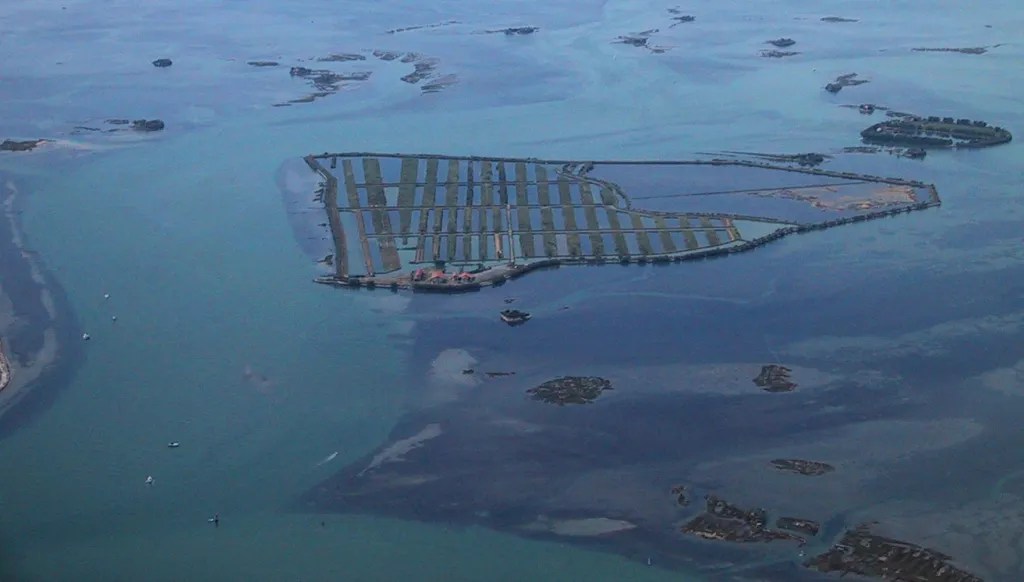
Isola delle Femmine
Gulf of Palermo, Sicily, Italy · 34 acres · Freehold
About This Island
Isola delle Femmine, the Island of the Women, is a small oval island in the Gulf of Palermo, off the northwestern coast of Sicily, that has belonged to the same aristocratic family since the 1600s. It is roughly 34 acres of sloping grassland and craggy limestone, rising to 35 metres at the foot of a ruined stone watchtower, surrounded by some of the clearest protected water in the Tyrrhenian Sea.
The family that has held it for four centuries is now offering it for sale.
The island is uninhabited, undeveloped but for the tower, and is a designated nature reserve at the centre of a marine protected area. This is not a resort-development opportunity. It is one of the rarest categories of property in the Mediterranean: a genuinely historic, ecologically protected private island, offered by the family that has stewarded it since before the Baroque, to a buyer who will steward it next.
The Name
The island's name has attracted legend for centuries.
The story most often told is that thirteen Turkish maidens, cast adrift by their families as punishment for some transgression, were shipwrecked on the island and lived there alone for seven years, after which their remorseful relatives found them and founded a mainland town they named Capaci (from cca paci, "here, peace"), while the island took the name Isola delle Femmine, the Island of the Women.
The history is more prosaic and, in its way, more interesting. The name is almost certainly the product of a long linguistic Italianisation. The most credible scholarly readings trace it either to Insula Euphemi, after Euphemius, the 9th-century Byzantine governor of Sicily, or to the Arabic fim (mouth, or inlet), a description of the island's narrow tuna-trapping bay, which passed through Sicilian fimi and was eventually reanalysed as fimmine, women. A royal decree of 1176 under William II already refers to the island as Fimi.
Whichever origin is true, the name has carried its own ghost stories for generations, of a girl seen singing and dancing along the shore. The current owner is candid that these are just stories. They are, however, very old ones.
The Tower
The centrepiece of the island is a ruined coastal watchtower on its highest ground, with a 360-degree view that reaches to the distant island of Ustica.
The tower is older than it first appears. The associated tuna fishery (tonnara) was documented as early as 1176, and the tower in its present form dates to a 15th-century rebuild, part of the network of coastal fortresses that defended Sicily against Saracen and Corsair raids between the 15th and 18th centuries. Built of tuff-stone blocks with walls close to two metres thick, it comprised a lower level that functioned as a rainwater cistern and an upper domed chamber for arms, provisions, and the garrison, topped by a parapet with gun ports.
Its ruin has a specific and recent cause. The tower was heavily damaged during the Allied landing in Sicily in 1943, as part of Operation Husky, the largest amphibious operation of the Second World War. After the war it was neither rebuilt nor maintained, and was for a time used by the US Navy as an outpost to patrol Sicily's northern coast. The decades of abandonment that followed brought it to its current state.
The tower can be fully rebuilt, respecting the original volume of the structure, subject to the approvals that its protected setting requires. Some original features survive, including an external loggia that would allow direct access to the first floor.
The Deeper History
The tower is not the only history on the island. Isola delle Femmine has been used by human beings for well over two thousand years, and the traces remain.
- Roman garum basins: the stone and lime-mortar tanks in which the Romans prepared garum, the prized fermented fish sauce of the ancient Mediterranean, survive on the island
- Ancient wells and cisterns cut to collect and store rainwater
- Roman anchors and relics lie on the surrounding seabed, part of what makes the waters an archaeological as well as an ecological site
- Over 120 plant species, including irises, mallow, and mandrake, across the grassland and cliffs
For a buyer with a cultural or philanthropic thesis, the layered antiquity of the island is the substance of its appeal, and the basis on which a restoration project would be assessed.
What Can and Cannot Be Done Here
Candour serves a buyer better than promotion on a property like this.
Since 1997 the island has been a designated nature reserve, for which the Italian League for Bird Protection (LIPU) is the managing authority. It sits within the Capo Gallo-Isola delle Femmine Marine Protected Area, established in 2001 and covering more than 4,000 hectares of protected sea, divided into zones of graded protection. The European Union has recognised the site's importance, classifying it first as a Site of Community Importance and then as a Special Area of Conservation.
What this means in practice:
- A resort is not possible. The protective designations preclude commercial resort development. A buyer expecting to build villas for return on investment should look elsewhere.
- Restoration of the tower is possible, respecting its original volume and the naturalistic constraints of the reserve, in cooperation with the local and national heritage authorities.
- The realistic end uses are a private residence within the restored tower, an archaeological or cultural museum, a research or conservation facility, or simply the acquisition of the island as a preservation piece and private retreat.
- Public funding may be available. For a development program that respects the surrounding nature, a new owner may apply for tax incentives and funding from the European Union or the Italian Ministry of Culture, for a cultural and touristic project compliant with the environmental constraints.
The honest framing is the one the market itself has arrived at: this is not an investment that will generate a commercial return. It is a piece of protected Sicilian heritage, available to a buyer for whom stewardship, privacy, and history are the return.
The Water
The waters around Isola delle Femmine are the island's living asset. The marine protected area is an elite diving and snorkelling destination, with translucent water, reef structures, and a marine ecosystem that includes lobsters, sea anemones, and madrepora stony coral. The seabed holds the Roman anchors and relics that make a dive here an encounter with antiquity as much as with marine life. The island is reachable even by non-professional divers, thanks to the clarity of the water and the shelter of the gulf.
The shores are made of tiny white pebbles, with one small sandy beach and a cove suitable for mooring a dinghy or a fishing boat. Wandering vessels caught in weather have used the island's inlets for shelter for centuries.
The Setting
Isola delle Femmine lies just off the coast of the town of the same name, on the Tyrrhenian shore northwest of Palermo. The town is a working Sicilian fishing village turned modern seaside resort, with a sandy beach, a fishing harbour, and a seafront promenade of restaurants.
- Palermo, the Sicilian capital, is 19 km away, with its UNESCO-recognised Arab-Norman architecture, its markets, its opera house, and its restaurants
- Monreale, with its extraordinary Norman cathedral and Byzantine mosaics, is 21 km away
- Palermo Falcone-Borsellino Airport is 16 km away, approximately 15 minutes by road, with direct flights from London, Paris, Rome, Milan, Frankfurt, Madrid, and most major European hubs
The island is one of the most accessible private islands in the Mediterranean, a short boat crossing from a mainland with a major international airport 15 minutes away.
The Position
Isola delle Femmine is a rare thing: a private Sicilian island with two thousand years of visible human history, a restorable medieval watchtower, Roman antiquities on the land and the seabed, and one of the clearest protected marine environments in the Tyrrhenian Sea, held by a single aristocratic family since the 1600s and offered now for the first time in generations.
It is not a property for a developer. The protective designations that make the island what it is also foreclose the resort economics that a buyer might imagine. It is instead a property for a specific and rare kind of buyer: one who wants to hold, restore, and steward a genuine piece of Mediterranean heritage, with the deep satisfaction that the role carries and the antiquity of the place as the reward.
The family has held it since before the Baroque. The next owner writes the next chapter of a very long story.
Everything You Need To Know
Italy
Detailed jurisdiction data for Italy coming soon. Browse our buying guides for general information.