
Motu Nao Nao
Raiatea Lagoon, French Polynesia · 75 acres
About This Island
Raiatea is the sacred motherland of Polynesia. According to oral history shared across the entire Polynesian Triangle (Hawai'i in the north, Aotearoa in the south, Rapa Nui in the east), this is the island from which the great voyaging canoes set out a thousand years ago to populate the Pacific. Marae Taputapuātea, the ancient ceremonial complex on Raiatea's eastern shore, was inscribed by UNESCO as a World Heritage Site in 2017 and is the most important spiritual and political centre of ancient Polynesia.
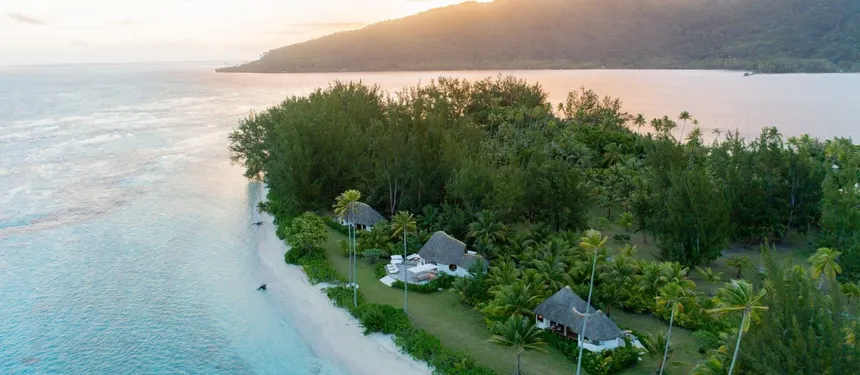
Motu Nao Nao is the small private island that sits 1.5 kilometres off Raiatea's southern coast, in the sheltered lagoon. It is, when rented, the closest private accommodation in the world to the cultural source of Polynesian civilisation.
It accepts a maximum of six guests at a time.
The Premise
Three handcrafted villas, designed by Raiatea-based architect Alain Fleurot, scattered across 75 acres of an otherwise empty motu. Each villa is built for two guests. Maximum total occupancy is six. The booking is exclusive: only one party is on Motu Nao Nao at any time, and the staff dedicated to that party scales to match.
This is not an isolation-by-default property. The lagoon, the helicopter to Bora Bora, the pearl farms, the UNESCO marae, the sailing canoes, the dive sites, and the second-largest island of French Polynesia are all reachable within thirty minutes. But what most guests find by their second or third day is that none of these places, however remarkable, are quite as compelling as not leaving the island.
The Three Villas
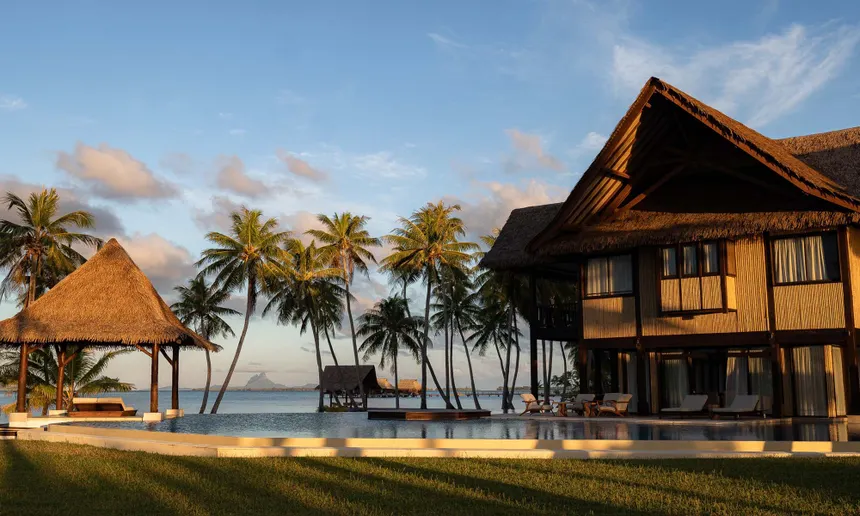
The villas are named for Polynesian roots. Each is freestanding, thatched-roof, fully air-conditioned, with king bed, outdoor deck, panoramic ocean or lagoon view, and the kind of bespoke craftsmanship that only emerges when an architect lives on the island they are designing for.
Villa Mana (103 m² / 1,108 sq ft), the largest of the three, is the social and culinary heart of the property. A king-size bed sits on a mezzanine overlooking the main living space. A fully equipped kitchen, a small wine cellar, an ice machine, and a Nespresso machine. The deck runs to 130 m² with outdoor dining, a fire pit, day beds, umbrellas, and a Sonos sound system that can be controlled from a smartphone. This is where breakfast and lunch are typically served, and where the rest of the property's social life centres.
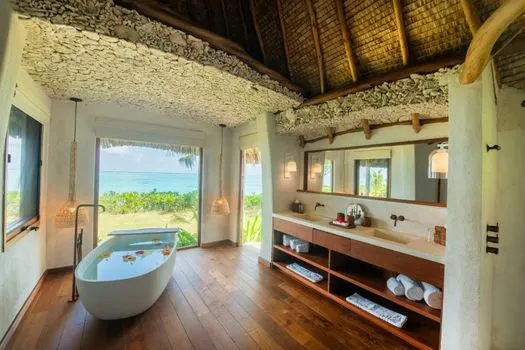
Villa Miri (72 m² / 775 sq ft) is the panoramic-shower villa. King-size bed, day bed, outdoor bathtub, an oversized bathroom with a shower opening to the trees, and a 57 m² deck with the same Sonos integration. Discreetly set apart from Villa Mana, with its own private path through the gardens.
Villa Mitti (61 m² / 656 sq ft), the smallest, is the quiet one. King bed, shower-and-tub bathroom, living room with sofa and desk, a 40 m² deck. The accommodation a third couple in a six-guest party occupies for the privacy they wanted by booking a private island.
All three villas share the Sonos infrastructure, the iPad-controlled smart features, the minibars, the Nespresso machines, and the daily replenishment by the resident staff.
The Chef
The kitchen on Motu Nao Nao is led by Chef Wilfrid Kobylt, whose practice is unusual enough to warrant explanation.
Kobylt is a trained chef and a trained chemist. His culinary work on the island includes ongoing research into the mineral and molecular compositions of the wild edible plants that grow on Motu Nao Nao, with the kitchen drawing not just on local fish and organic vegetables but on tropical plants and wildflowers that he forages and analyses himself. The result is a Polynesian cuisine that is genuinely original: rooted in the islands' traditional ingredients, refined through laboratory-grade understanding of what those ingredients actually contain, and presented in a dining-room setting that overlooks the lagoon.
For a guest who has eaten at the leading restaurants of Paris, Tokyo, and Lima, Kobylt's table is one of the rare experiences in luxury hospitality that is genuinely new. He cooks for one party at a time, which means the menu is calibrated to the specific guests in residence rather than to a fixed inventory or seasonal cycle.
What the Rate Covers
- All three meals daily, prepared by Chef Kobylt and his team, with both Polynesian and international influences
- Beverages with meals (standard wines, beers, soft drinks, juices)
- Kayaks, paddleboards, bicycles, snorkelling gear, and the use of the outdoor cinema, the fitness equipment, and the karaoke setup
- One included excursion per day per guest: choices include scuba diving, jet ski, lagoon boat tour, 4x4 mainland safari, Va'a Holopuni sailing canoe, massage, Polynesian nature and culture tour, yoga, and Pilates
- Daily housekeeping, dedicated villa attendants, around-the-clock staff
- The pearl farm tour and outdoor movie nights, ongoing as guest preference dictates
Typical Additional Costs
- Premium-brand spirits and wines beyond the standard inclusions
- Helicopter day trips to Bora Bora and other nearby islands
- Private dive certification courses
- Specialist commissions arranged through the concierge (private flight lessons, photographer or videographer commissions, customised wellness programmes)
A guest at booking is invited to share dietary preferences, anniversary or celebration dates, activity interests, and any specific cultural experiences they want included. The property responds.
A Day, In Sketch
Mornings start with the sound of the lagoon and the birds in the canopy. Coffee is delivered to your villa or to Villa Mana's deck, whichever you prefer. Breakfast follows when you ask for it, with fresh-baked bread, the night's catch transformed into a Polynesian breakfast composition, and fruit cut moments before it reaches the table.
The day, like every other choice on Motu Nao Nao, is yours to shape. The activity menu is generous. Most guests, by their second or third morning, find themselves picking one thing rather than three.
Many days begin with the Va'a Holopuni, the traditional Polynesian sailing canoe, which a local instructor brings to the dock for a paddle into the lagoon. The Va'a was the vessel that carried Polynesian navigators across the entire Pacific Ocean for nearly two thousand years. Learning to handle one, even briefly, is the closest a contemporary visitor comes to the seafaring tradition the islands are built on.
A morning at Marae Taputapuātea is the cultural high point of any stay. The ceremonial complex, a thirty-minute boat trip away on the eastern shore of Raiatea, was the religious and political centre of pre-contact Polynesia. Visiting it with a local guide who can explain the spiritual significance of the platforms and the orientation of the stones is unlike visiting any other archaeological site in the Pacific.
Pearl farm tours visit small working operations on Raiatea where Tahitian black pearls are cultivated, with the chance to see the grafting process and to select pearls directly from the farmers. Lagoon boat tours, fishing trips, scuba diving on Raiatea's dive sites (one of which holds a sunken three-masted sailing ship from the 19th century), and 4x4 safaris into Raiatea's mountainous interior fill out the menu.
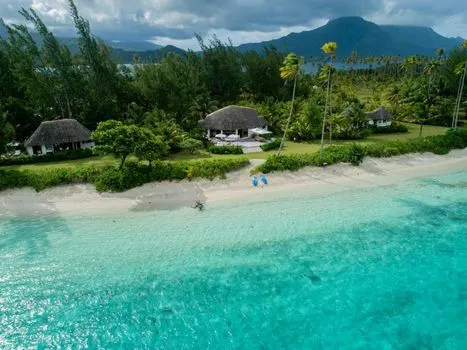
For those who simply want to remain on the island: snorkelling from the 800-metre beach, walks through the forest interior, a Polynesian dance lesson on Sunset Beach with a local instructor, the outdoor cinema with the projector pointed at a screen set up in the sand, or nothing at all.
Dinner is on Villa Mana's deck. Cocktails at sunset, followed by Chef Kobylt's evening menu. Late evening is the fire pit, the stars, the soundtrack of the lagoon.
The Cultural Position
Motu Nao Nao operates with explicit respect for the Polynesian people and their cultural heritage. The activities offered, from the Va'a Holopuni to the ori Tahiti dance lesson to the visit to Taputapuātea, are taught and led by Polynesian practitioners. The chef sources locally and sustainably. The architecture by Alain Fleurot was conceived as Polynesian rather than as international-tropical-luxury imported to a Polynesian site.
For a guest who has noticed that much of luxury hospitality in the Pacific borrows the imagery of Polynesian culture without engaging the substance of it, Motu Nao Nao is the alternative position.
Weddings and Celebrations
The exclusive-use structure and the maximum six-guest capacity make Motu Nao Nao well suited to intimate weddings, anniversaries, milestone birthdays, honeymoons, and small family or close-friend gatherings. The property has hosted weddings on its 800-metre white sand beach with the lagoon as a natural altar, and the staff can coordinate everything from the ceremony itself to the celebrant, the music, the floral arrangements, and the photography. For a couple looking for the most culturally meaningful private wedding location in the Pacific, this is the position.
Access
- From international hubs to Tahiti: Faaʻa International Airport in Papeete receives direct flights from Los Angeles (8 hours), Auckland, Tokyo, Paris (via Los Angeles), and Santiago de Chile
- From Tahiti to Raiatea: 45 minutes by Air Tahiti domestic flight, with multiple daily departures
- From Raiatea Airport to Motu Nao Nao: approximately 5 to 10 minutes by the property's private speedboat
- By helicopter: direct private helicopter transfers from Tahiti or Bora Bora can be arranged
- Minimum stay: four nights, with most guests choosing six
A guest leaving Los Angeles in the morning is on Motu Nao Nao's deck by sundown the next day.
What Motu Nao Nao actually rents is the rare combination of three things that almost never coexist in luxury travel: total privacy (six guests, dedicated staff, exclusive-use booking), genuine cultural depth (the sacred motherland of Polynesia, with Taputapuātea on the next island), and the kind of contemporary architectural and culinary craft (Fleurot's villas, Kobylt's kitchen) that converts a beautiful place into a memorable one.
The Pacific has many private islands. Motu Nao Nao is the one that takes itself seriously as a place rooted in a specific culture, and rewards the guest who takes it seriously back.
Everything You Need To Know
French Polynesia
Detailed jurisdiction data for French Polynesia coming soon. Browse our buying guides for general information.